
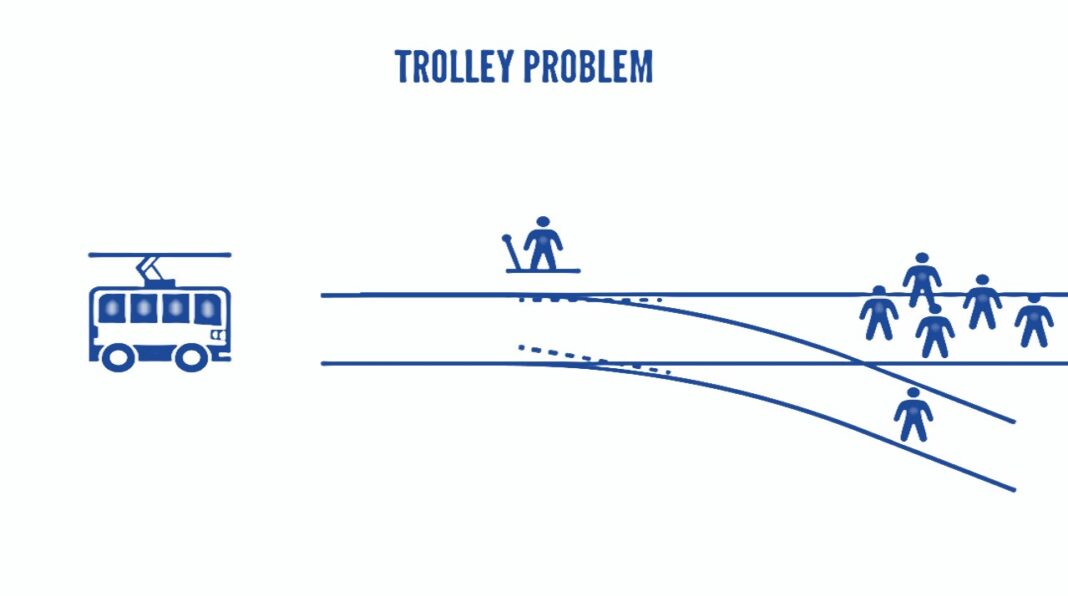
Illustration of the trolley problem. Image courtesy of Curious Matrix.
In 1967, Philippa Foot developed the moral dilemma referred to as the trolley problem. The trolley problem presents the dilemma of choice in high stake situations involving the lives of multiple people.
In this moral dilemma, you are standing on a trolley platform controlling the lever of a trolley’s path. One path has one person tied down while the other restrains a group of people. The trolley automatically follows the path leading toward the group, and is determined by the direction in which you pull the lever. Which path would you choose the trolley to take?
The most utilitarianistic approach is the decision to save the most people in hopes of making the most morally correct decision. By choosing one person, the most lives are saved, but you have made the decision to actively change the course and kill the one person.
According to a study done by Joshua Greene in 2001, 90% of people choose to save the majority by pulling the lever in the direction of the one individual. However, certain factors change the decision. For example, if one person is your loved one, the lever operator is more likely to not pull the lever.
The main objective with the trolley problem is to focus on the doctrine of double effect. Is the harm intended, or acknowledged but unintended?


.png)



.jpg)
