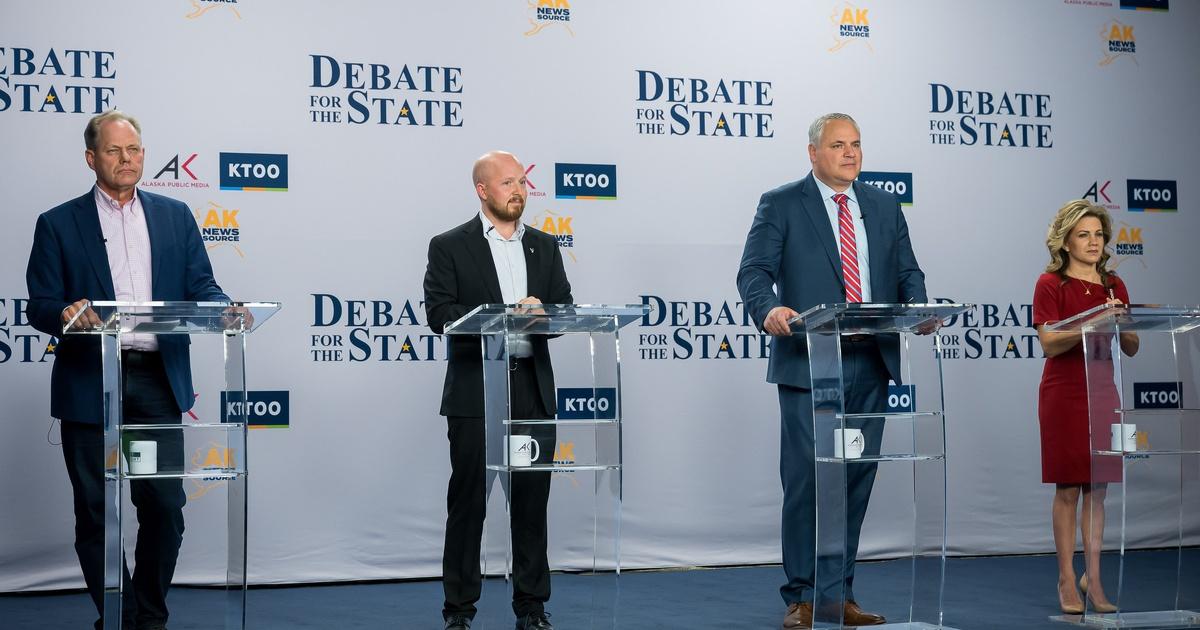
Gubernatorial candidates at Debate for the State. Photo courtesy of PBS.
Debate for the State 2026: Alaska Governor was simulcasted on TV, radio and online on Oct. 8. Alaska Public Media’s Lori Townsend moderated the debate. Questions were asked by Alaska Public Media’s State Government Reporter Eric Stone, and Alaska’s News Source Political Reporter Wil Courtney. Alaska Public Media also asked Alaska residents to send questions they wanted answered during the debate.
The order of candidates answering questions was drawn out of a hat beforehand.
The first question of the debate referred to the state’s long-term fiscal plan to solve the deficit. Stone asked how candidates would meet state revenue expenses.
Dave Bronson answered first, and said, “We’ve got to audit our departments and find out where they’re wasting. But more so, on the revenue side, we need to stimulate private industry to develop our resources for us.”
Jonathan Kreiss-Tomkins proposed a balanced budget, and supported enforcing corporate income tax for Hilcorp.
Treg Taylor opposed raising taxes, and expressed a focus toward expanding the economy.
Bernadette Wilson spoke about government audits, automation of services, changing budget methods and a spending cap.
Courtney then asked candidates about the statutory Permanent Fund Dividend (PFD).
Kreiss-Tomkins argued for a constitutional protection against overspending that would allow for a long-term fiscally sustainable PFD.
Taylor said, “We need to get as much money into the hands of Alaskan families as possible. We do that by growing our economy.”
Wilson advocated for a statutory PFD, while Bronson said the PFD needs to grow to a point that it would help fund itself.
The third question raised concerns about education and how candidates would address related issues in a sustainable way.
Taylor said that placing accountability provisions back into the Alaska Reads Act is necessary to move forward, and emphasized funding classrooms and teachers and focusing on the basics of education.
Wilson said that discrimination in income inequality must end and that she will use AI technology to improve individualized learning plans.
Bronson argued that kids need to be taught how to think, not what to think.
Kreiss-Tomkins said he would forward fund education in full and improve benefits for teachers.
Michael Ladouceur from Fairbanks raised a question about statewide pension for state workers. Wilson and Bronson both claimed that the state cannot afford it.
Kreiss-Tomkins rebutted that pension would not create unfunded liability and would instead assist in retention rates.
Taylor said he does not like pensions because they trap state employees and used 401(k)’s as an example.
Courtney said that gas supply in the Cook Inlet is likely to fall short of demand in the near future and asked how candidates would approach the possible consequences of the gas line.
Kreiss-Tomkins advocated to “diversify energy resources on the rail belt, and that means natural gas. That also means hydro, that means wind, that means solar.”
While Bronson and Taylor supported exploring the Cook Inlet for gas, Wilson said there is an energy crisis in Alaska, and said, “we’ve been a terrible business partner to our oil and gas industries.”
Stone asked how candidates would ensure Alaskans are safe from increasingly dangerous storms.
Kreiss-Tomkins advocated for stronger partnerships between the state and federal government, as well as tribal partnerships in rural Alaska. He advocated for a disaster response so that the state is ready in case of emergencies.
Taylor said he wanted to prepare for natural disasters with advanced planning with a focus on food security during the disaster.
Wilson praised the National Guard for their service, and agreed that more cooperation with the federal government and rural Alaska communities is necessary.
Bronson said having resources and funding for emergency response programs is necessary for future disasters.
Courtney asked if excessive salmon bycatch was a priority to the candidates. Taylor said that one group should not benefit at the expense of others.
Wilson said “we need to talk about putting observers on boats and having more accountability when it comes to that conversation.”
Bronson said bycatch is a high priority for his campaign, and emphasized the impacts of trawling.
Kreiss-Tomkins recognized rural communities that rely on fishing for subsistence and said that the state needs to prioritize resources for residents and communities.
Anchorage Youth Vote’s David Pak asked candidates what they would do to keep young people in the state.
Wilson began the discussion emphasizing investment in vocational and educational programs for students, while Bronson highlighted the cost of living and the importance of giving students the option to attend trade schools or college.
Kreiss-Tomkins also discussed the cost of living and housing, and said “we need to unleash a housing building boom,” in hopes that increased supply of housing will drive down costs.
Taylor emphasized aligning the education system with Alaska’s workforce needs by decreasing the cost of living and moving the economy forward by accessing natural resources.
Courtney then asked how the candidates perceived their counterparts and how they would demonstrate compromise for the benefit of Alaska.
Bronson described his relationship with Tomkins, and said “I’m a man of the right and he’s definitely a man of the left, but we can work together.” Bronson recalled his work in Juneau, where Bronson worked with others who were on opposite ends of the political spectrum, and still got things done.
Kreiss-Tomkins said that compromise is a virtue and that work in Juneau has become dysfunctional due to the inability to see beyond political affiliations.
Taylor said he used his experience as attorney general to represent how he has and will continue to work across the aisle by treating others with dignity and respect.
Wilson said “Coffee and cocktails isn’t going to do it.”
Courtney asked the candidates how they would address the cost of living and relieving financial pressure.
Kreiss-Tomkins reiterated his platform of pro-housing and renewable energy such as solar, hydro and natural gas, and added that the cost of childcare also needed to be addressed.
Taylor claimed the gas line project would provide more jobs, and reiterated the importance of growing the economy by making Alaska more business friendly.
Wilson stressed reducing the cost of energy and housing and promised a clear timeline on delivering permits for business owners.
Bronson concluded the round by saying the Trump administration has been more beneficial for private enterprise development than previous administrations.
To watch the full debate, including the lightning round and closing statements, the transcript and recorded livestream are available on Alaska Public Media’s website.