
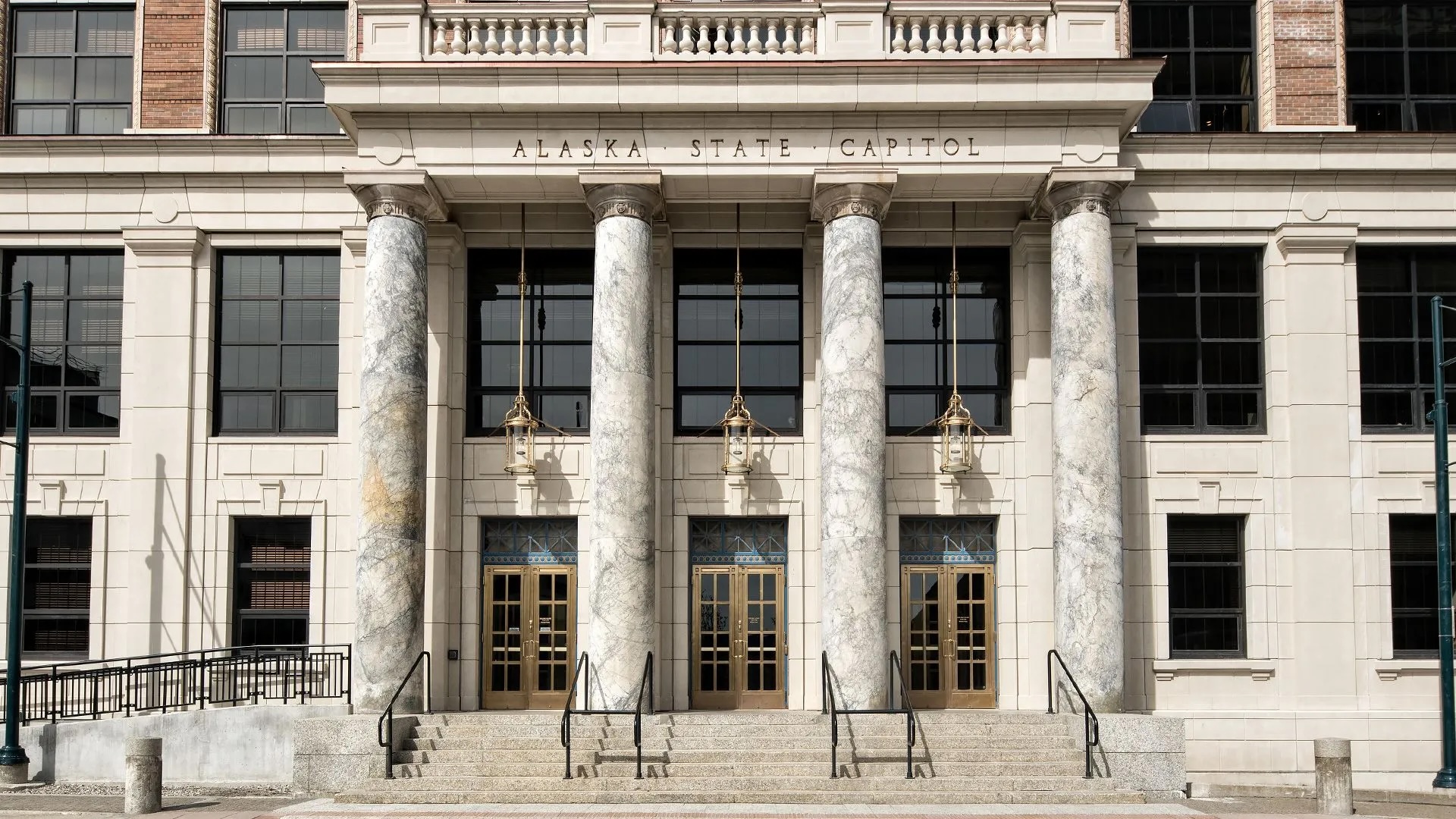
Entrance of Alaska State Capitol located in Juneau, AK. Photo courtesy of SSFEngineers.com
Alaska’s primary election suggests that the Alaska Legislature heading into 2027 may look more familiar than different.
There are competitive races and important leadership vacancies, but many of the legislators who currently shape budgets, negotiate major legislation and hold together bipartisan governing
coalitions appear well positioned to remain central players next year.
Several of the Senate’s most influential members emerged from the primary in exceptionally strong positions. Senate Majority Leader Cathy Giessel received 62 percent of the vote against three Republican challengers and is widely expected to remain at the center of the next Senate organization.
Bill Wielechowski, who chairs the powerful Rules Committee, and longtime Finance Co-Chair Bert Stedman were both unopposed. Together, their results suggest that much of the Senate’s existing leadership and institutional power structure is likely to carry into the next two-year legislative session.
Some meaningful turnover will still occur. Senate President Gary Stevens is retiring, and Lyman Hoffman is leaving one of the Senate’s most important finance roles.
However, the emerging leadership picture in their absence looks relatively predictable. Bryce Edgmon and Louise Stutes both appear well positioned in their Senate races. Edgmon finished first in the Senate District S primary with 37.86 percent, while Stutes finished first in Senate District C with 49.37 percent.
If elected, neither would enter the Senate as an ordinary freshman.
Edgmon brings years of experience as House Speaker and as one of the Legislature’s most experienced bipartisan coalition builders.
Stutes is a former Speaker and a senior coalition member with deep institutional experience. Both would be natural candidates for influential roles within the Senate majority.
The House shows much of the same pattern. Chuck Kopp was unopposed, Zack Fields led comfortably and Calvin Schrage received nearly 69 percent of the vote.
Several House races could affect the coalition’s margin. Republican-held seats in House Districts 6, 11 and 15 all look competitive based on the certified primary results. Brent Johnson finished nearly 14 points ahead of Republican incumbent Sarah Vance in District 6, 56.87 percent to 43.13 percent. In District 15, Democrat Denny Wells finished ahead of Republican incumbent Mia Costello, 52.74 percent to 47.26 percent. And in District 11, Republican Julie Coulombe finished only 55 votes ahead of Democrat Danni Hall, 50.57 percent to 49.43 percent.
There are also open seats where Republicans do not appear positioned for easy gains. Democrat Cliff Groh received more than two-thirds of the primary vote in House District 18, the seat being vacated by Republican David Nelson. In House District 34, nonpartisan Joy Beth Cottle finished ahead of Republican Harmony Tomaszewski.
None of these results decide the November outcome, but together they show where the defensive pressure currently sits. The Republican minority has several existing seats to protect and relatively few obvious opportunities to offset potential losses elsewhere.
That makes it increasingly likely that the House will again be organized by a bipartisan, Democratic-led majority, potentially with an even more comfortable margin than it has today. A larger majority gives leadership more room to absorb defections, move legislation and manage committee assignments without every close vote becoming an organizational test.
Taken together, the legislative picture is becoming fairly clear. The Senate bipartisan majority looks durable, while the House coalition has a realistic path to expanding its margin. Some leadership titles will change, but many of the people exercising real influence in Juneau are likely to remain the same.
That matters for the governor’s race.
The governor’s race has changed considerably since primary night. Jonathan Kreiss-Tomkins finished first in the certified results, followed closely by Tom Begich. Begich has since withdrawn and endorsed Kreiss-Tomkins, consolidating the Democratic side of the field around one candidate.
Republicans have not consolidated in the same way. Bernadette Wilson and Dave Bronson remain separate candidates, while the fourth position has become complicated by Treg Taylor’s ballot eligibility. Taylor would have moved into the top four following Begich’s withdrawal, but the lieutenant governor announced Monday that his nomination would not be certified following an Alaska Public Offices Commission finding related to his financial disclosure filing.
Whatever the final configuration looks like after the Aug. 31 withdrawal deadline, the larger point remains: Republican primary voters should not be treated as a single bloc that will automatically consolidate behind Wilson or Bronson.
The Republican field drew support from several different constituencies. Voters who supported Click Bishop, Treg Taylor, Shelley Hughes, Adam Crum and others may weigh experience, governing style and legislative relationships differently.
Begich’s withdrawal therefore creates a meaningful asymmetry heading into November. Democrats have consolidated behind Kreiss-Tomkins. Republicans, at least so far, have not.
Whether any particular combination happens is less important than what the primary revealed: the current percentages do not represent fixed blocs of general election support. The larger question is what kind of governor can work with the Legislature voters appear likely to send back to Juneau.
Alaska’s political debate tends to focus on the biggest and loudest issues. The Permanent Fund dividend, education, oil taxes, large capital projects — those fights matter, but they are only part of governing.
A large amount of legislation is less dramatic. It may have broad support. It may fix a technical problem, update an outdated statute or respond to an issue that legislators from both parties agree should be addressed. These bills rarely dominate campaign advertising, but they are a significant part of what the Legislature actually does.
They can still be difficult to move when the executive and legislative branches are locked in conflict. That has been one of the recurring challenges during the Dunleavy years. An antagonistic relationship between the governor and bipartisan legislative coalitions can affect more than the issues generating headlines. It can make the entire legislative process less predictable, including
for bills that are not particularly partisan or controversial.
That dynamic could become important again in 2027.
Wilson has positioned herself closer to the faction of Republicans most critical of bipartisan legislative coalitions. If she becomes governor while those coalitions continue to control the House and Senate, the relationship between her administration and legislative leadership could become one of the defining issues of her term.
Kreiss-Tomkins brings years of legislative experience and longstanding relationships with legislators likely to remain influential next year. Other candidates in the race bring very different histories with the Legislature and with bipartisan governing coalitions. Those differences may matter considerably once campaigning gives way to governing.
The primary results therefore point toward an interesting contrast. The Legislature appears likely to remain under bipartisan, Democratic-led control, while the governor’s race remains unsettled.
Leadership titles will change, several competitive races could adjust coalition margins, and experienced legislators may move between chambers. Still, many of the people at the center of legislative power appear likely to remain there. If several of the competitive House races break against the current Republican minority, the next governor may face not just the same coalition structure, but a stronger version of it.
The next governor will have to govern with them. And when the campaign is over, the ability to do that may matter just as much as where candidates stood on the biggest issue of the day.
This commentary is based on the latest official election results and information available as of August 31, 2026 at 3 p.m. The candidate withdrawal deadline is 5 p.m., and the general-election field may still change.


.png)


.jpg)
