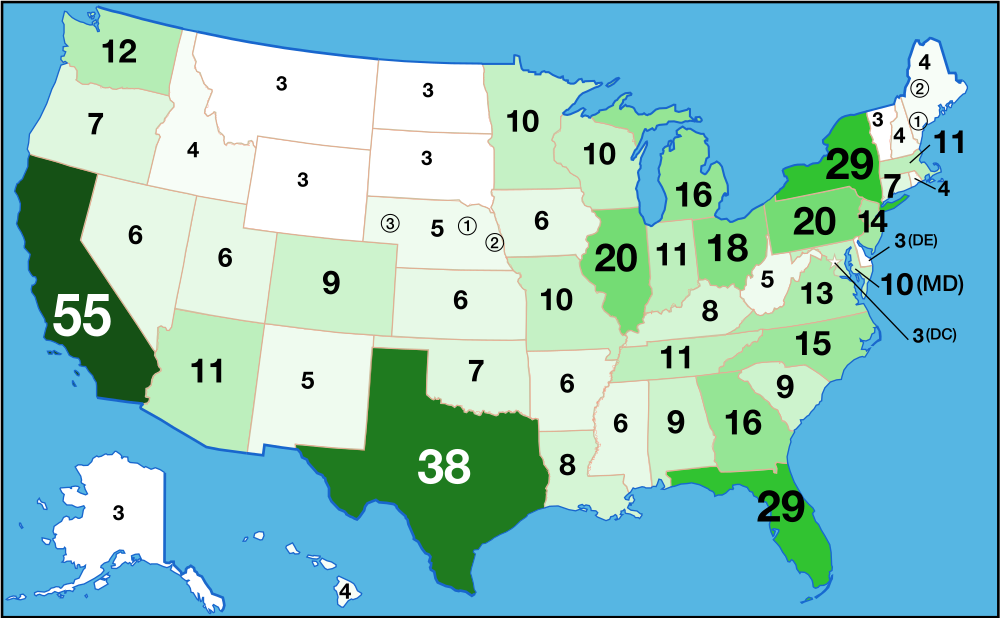
A map of the Electoral College showing each state and their votes. Photo courtesy of the League of Women Voters.
The United States elects its president and vice president through the Electoral College. The system works by having voters elect “electors,” who then cast their vote for president and vice president. Electors are individuals chosen by each state who do not hold an official government office for the purpose of electing the President.
During the 1787 Constitutional Convention, the Founding Fathers debated on how presidents should be elected, including whether the president should be chosen through popular vote or by Congress. They compromised by creating the Electoral College.
The Electoral College assigns an equal number of electors to each states’ total number of senators and representatives in Congress. The system provides more influence to smaller states and incentivizes candidates to campaign across multiple states rather than focusing solely on the most populous states.
However, as times have changed, I believe the Electoral College’s pros far outweigh its cons.
For one, the Electoral College allows a presidential candidate to win the presidency despite losing the popular vote. Most recently, Donald Trump won the 2016 presidency with 77 more electoral votes than his opponent, Hillary Clinton. Clinton received approximately 2.8 million more votes than Trump in the popular vote.
Politics aside, I think it goes against the very concept of democracy to elect someone who lost the popular vote. The purpose of voting in a democracy should be to give voters the best possible outcome that most closely aligns with their vote. The outdated Electoral College can disadvantage the majority and result in an unsatisfying outcome.
Furthermore, the Electoral College fails to prioritize the impact of voters from smaller states. Instead, medium sized “swing” states — states where either party has a chance at winning — become the focus of presidential candidates.
The National Popular Vote Interstate Compact (NPVIC) was created by the National Popular Vote organization and seeks to shift the elections toward the popular vote. The NPVIC could be a hopeful catalyst for change.
States that join the NPVIC pledge to award their Electoral College votes to the candidate who wins the national popular vote.
While there can be conflicts over using the popular vote to determine the next president, at least it would not result in a president who lacks majority support from voters nationwide.