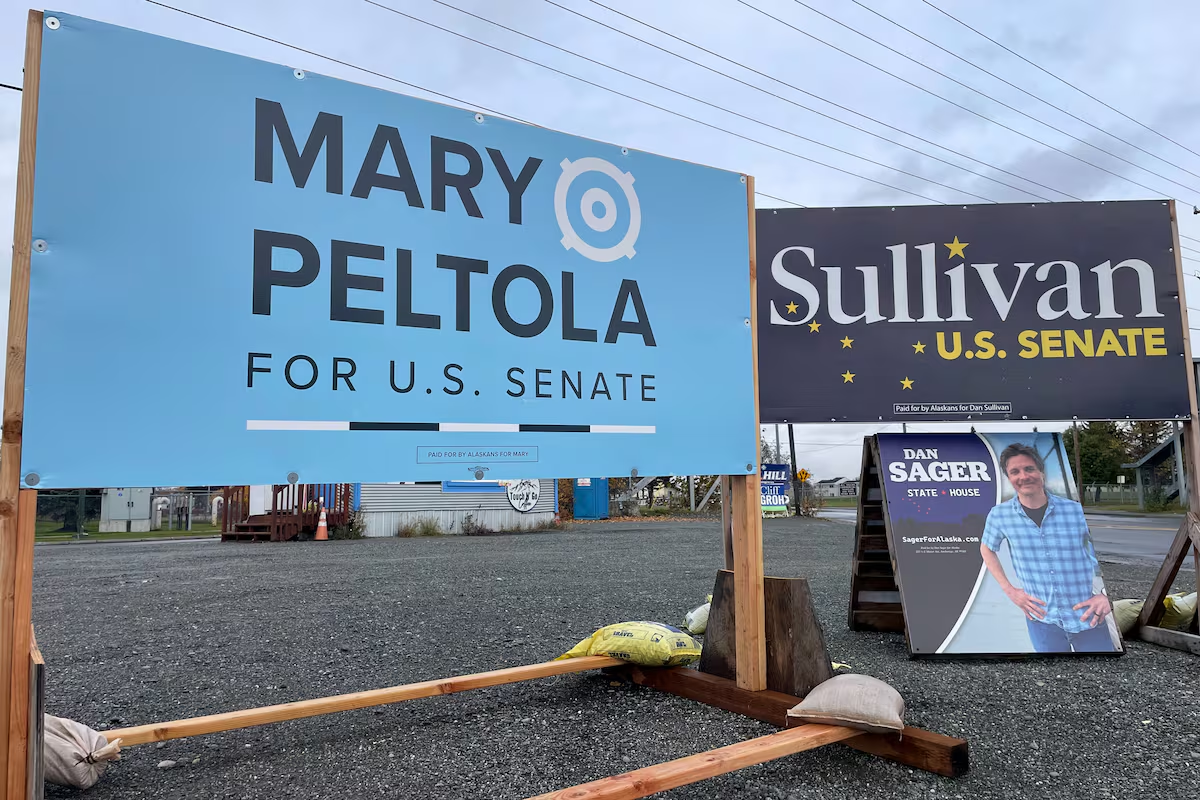
Campaign signs for Mary Peltola and Dan Sullivan, two of the most active campaigners. Photo courtesy of Anchorage Daily News.
Election season can feel uncertain as a new round of politicians take office. What will change? Will we lose Medicaid? Are we finally going to get out of that war? Is he really going to keep that promise?
However, many people aren’t thinking about important issues. Instead, they’re dealing with information overload from one of the most annoying parts of election season — the advertisements.
Whether they appear on television, the internet, through the radio, in your mail or at your front door – it’s inescapable. My own grandparents canceled their phone plan just to escape the constant stream of phone calls.
What purpose do these advertisements serve? Advertising could persuade people to visit a new restaurant or to watch a television show, but rarely do they convince someone to vote for a particular candidate.
In my experience, I haven’t heard anyone form a political opinion or learn something new from the slew of political advertising each year.
According to a study conducted by Yale News, television ads had nearly no influence on how people voted.
Political advertising becomes increasingly negative over time. Rarely do I see an advertisement discussing the positive attributes of a candidate or their policies. Instead, it has become a constant stream of smear campaigns.
These advertisements do nothing to unify us as a community. Is this the kind of society we want to live in? One where we do not focus on the qualities we want in a candidate, but rather the supposedly “evil” traits of the candidates we oppose?
What bothers me most is the use of the word “liberal” as a negative term. Some advertisements use the term to describe other candidates in a negative way. Because “liberal” is often used as a political buzzword, I’ve arrived at the conclusion that most Americans are unable to define it.
Merriam-Webster defines “liberal” in the political sphere as “a person who believes that government should be active in supporting social and political change.”
Because of polarizing advertising campaigns, people may begin to associate the word with morally corrupt politicians rather than those who support social and political change in government.
No matter where someone falls on the political spectrum, I hope we can recognize how dangerous an “us versus them” mentality is.
As we approach the conclusion of election season, I recommend you form your own opinion based on your morals, hopes and ideas. Then, consider which politicians align most with what you want out of government.
Don’t let advertisements dictate your opinions, and don’t base your beliefs on those of your peers.
Be open to the opinions of others and treat people with kindness, regardless of who they voted for.