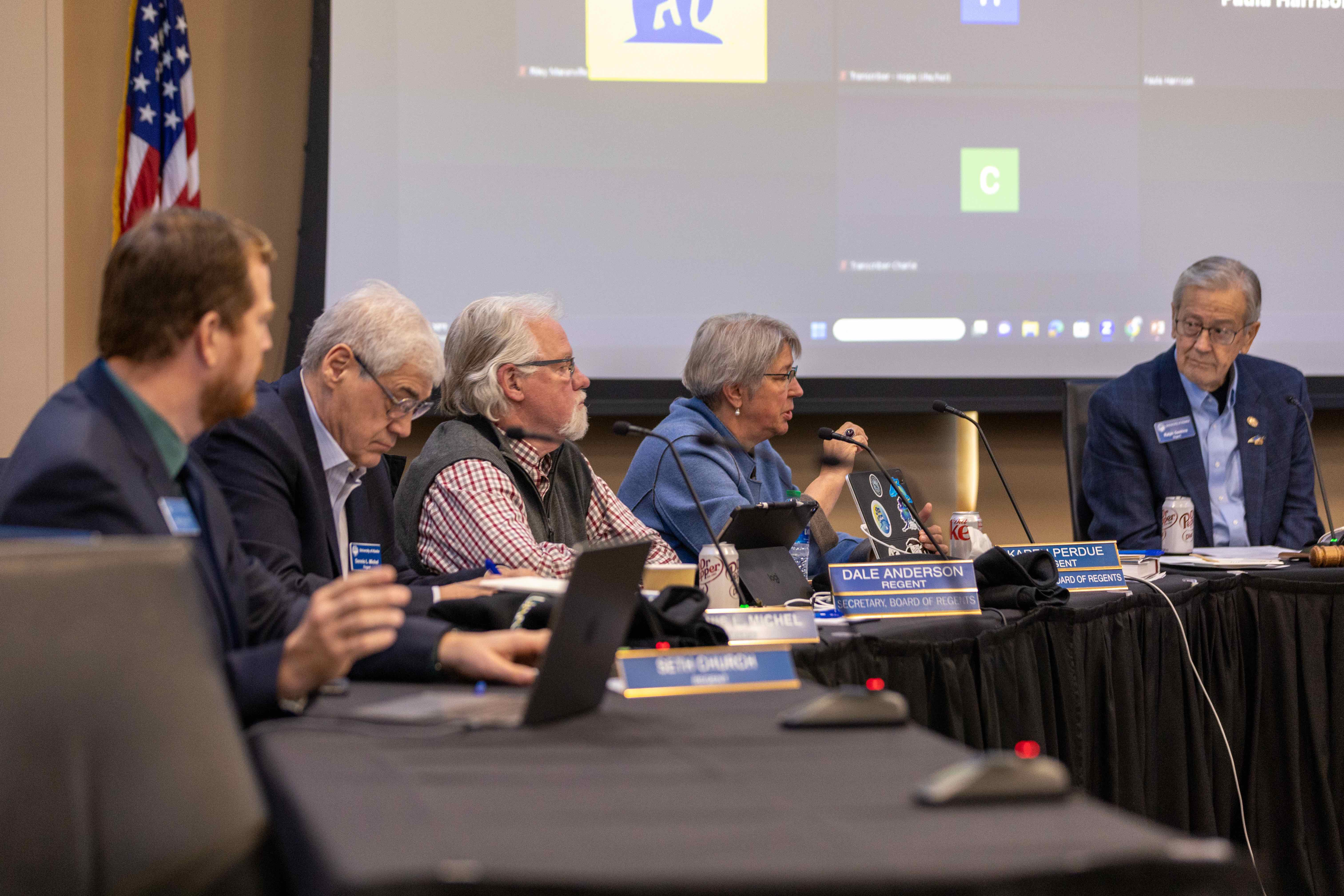
Board of Regents meeting Nov. 2024. From left to right, Regent Seth Church, Regent Dennis Michel, Regent Dale Anderson, Regent Karen Perdue and Regent Ralph Seekins. Photo by Matthew Schmitz.
University of Alaska’s Board of Regents (BOR) is the governing body responsible for creating policies and overseeing management of the UA system. The board holds public meetings to discuss and vote on proposals set forth by UA system administrators.
The board consists of 11 members selected by the governor and approved by the Alaska Legislature. Each regent is eligible to serve on the board for eight years while the appointed student regent is eligible to serve two years.
Regents may serve consecutive terms if approved by the governor.
The UA BOR has discussed and voted on policies such as tuition increases, the assessment and elimination of UA’s Diversity, Equity and Inclusion practices, budgetary analysis and student success.
Dale Anderson is the longest-serving member of the current BOR. He was appointed by Gov. Parnell in 2012 and re-appointed by Gov. Dunleavy in 2021. His term expires in 2029.
The newest members of the BOR are Secretary Christine Resler and Student Regent Fernando Escobar, both appointed in 2025 by Gov. Dunleavy. Resler will remain in office until 2033 while Escobar’s term will end in 2027.
The BOR appoints the UA system’s president. In May 2026, the board selected former UA General Counsel Matthew Cooper to succeed former President Pat Pitney, who retired that month. Cooper began his term on Aug. 3.
UAA students do not directly elect the BOR’s members, but they can influence its composition by voting in state elections.
Voting in gubernatorial and legislative elections presents students with an opportunity to influence who appoints and confirms the people responsible for overseeing the UA system.
Students can also participate in university decision-making through UAA’s student government, the Union of Students of the University of Alaska Anchorage (USUAA).
By engaging with student representatives, students can raise concerns and advocate for their interests when university policies are discussed by appointed BOR members.