
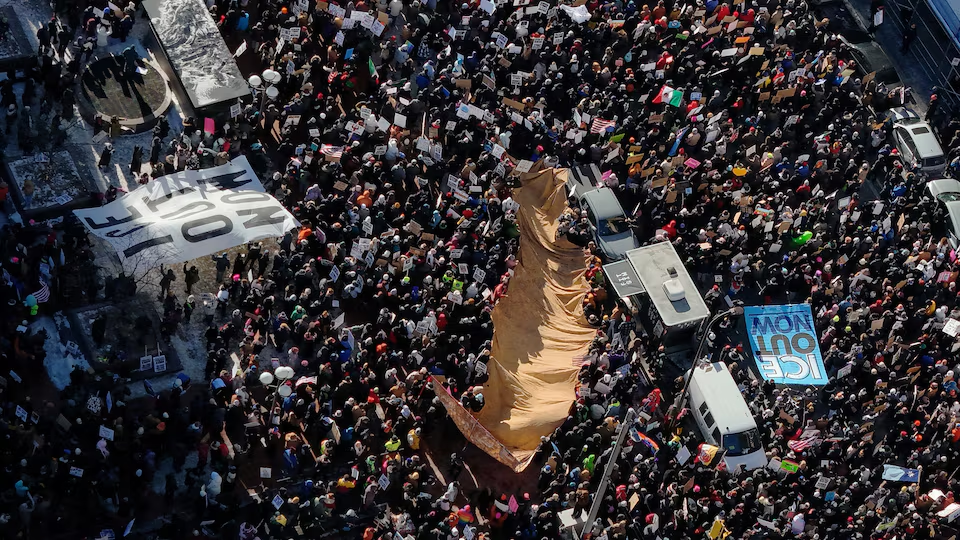
Photo by Brian Snyder, courtesy of Reuters
On Jan. 24, the nation watched in horror as Immigration Customs Enforcement, or ICE, officers shot and killed 37-year-old Alex Pretti, an ICU nurse in Minneapolis, Minnesota. Pretti’s execution marks the eighth death at the hands of ICE officers since the beginning of Trump’s second administration.
Only two weeks after the murder of Renee Good, the back-to-back killings called thousands of people to action in the Minneapolis area, along with calls of solidarity echoing across the nation.
The images coming out of Minneapolis invoke memories of the similar Black Lives Matter movement, which occurred almost six years ago. While the number of people who’ve stepped forward to participate in the public demonstrations is impressive, is it enough to facilitate actual change?
The topic of what is and isn’t considered legitimate activism is one that resurfaces rather frequently in leftist spaces. In an era where the majority of interaction with politics occurs on social media and the internet, there is no doubt that engagement and redistributing information has become conflated with actual activism.
Many individuals often lean into the notion that passively engaging with political content is, in and of itself, a form of activism. By comparison, taking to the streets and marching is viewed as a more intense and disruptive course of action.
Before I delve any further into this argument, I want to acknowledge that engagement over social media can be a much more viable option for individuals with disabilities due to a general lack of institutional and infrastructural accessibility.
Even though our current media landscape provides endless opportunities for information and resources to reach countless people, at what point does internet activism stop being productive? How would we, as a society, be able to facilitate in-person action and change?
During tumultuous times, it’s important to take a step back and evaluate how media and imagery often propel us into action without proper preparation. Much of the news that we consume is purposely designed to elicit strong, emotional reactions.
Videos of people being rounded up by ICE and protesters marching by the thousands invokes the urge to take immediate action that will grant us immediate results, and this is where many movements fall flat.
Anyone who’s done a thorough critique of American politics and governance knows that there is no reforming the current system — in order to create a nation suitable for everyone, it must be restructured entirely.
Until then, the best we can do is work together to create a materially better life for ourselves and our neighbors. Thriving is one of the best forms of resistance there is, and in order to thrive, community building and organization is one of the best ways to accomplish this.
The anarchist concept of mutual aid can be traced back to Peter Kropotkin in the early 1900s. The theory was originally raised as an alternative to social Darwinism. It made the argument that mutualism among humans is integral for the survival of our societies.
Regardless of what it takes the form of, the key to mutual aid is establishing a support network for the members of our community. There are a plethora of community resources offered to lower income individuals, but for folks that live marginally above the poverty line, many of those resources aren’t accessible. It’s up to everyone to contribute what they can toward filling in those gaps.
On an individual level, taking this sort of action can look like joining preexisting community organizations that prioritize aiding people in a skill set that you specialize in. Alternatively, aid groups can also start
among friends, where people provide support as needed with whatever resources they have the capacity to share.
This is an oversimplification of how mutual aid works, but establishing a clear objective — and laying out those steps — makes the task much less daunting.
That brings me to the next point: We as a society have a severely warped perception of time and results.
If the steps toward your goal aren’t easily visible, then it’s easy to feel stuck in a state of limbo. The biggest key to ensuring that community organization and mutual aid will be successful is consistency.
Volunteering or donating on a consistent basis ensures that a safety net is always there, and when more people contribute, the work feels less taxing.
Bringing this back to current events, even though it makes sense to divest from ICE through a general strike — since many people have their taxes taken out of their paychecks — having a strike for one day does little to remedy the issue.
Under our current system, many people do not have the resources to take one day off of work, let alone enough time for our economy to substantially be impacted. Having support networks and community resources in place for those individuals is what’s vital for making any long-term form of protest worthwhile.
Investing time and resources into your community can be exhausting. As much as we would like to live in an idealistic society, where mutual aid can be continuous and stable, the truth is, it’s a resource that lasts as long as we do. This is one of the biggest pitfalls for mutual aid, and that’s where the last tip comes into play.
Rest can also be a powerful tool of resistance if utilized properly. The design of the machine is to keep people too tired to resist and too distrustful to rely on our neighbors. Ensuring that we are well-rested on a consistent basis is a huge ordeal.
This concept can be attributed to the late Audre Lorde, a pioneer in intersectional politics. After being diagnosed with breast cancer at 44, Lorde further implemented the perspective of disability into her writing and activism. In a powerful declaration of revolutionary action, Lorde explained that “caring for [herself] is not self-indulgen[t], it is self-preservation, and that is an act of political warfare.”
Knowing your limitations is not only a great way to ensure that you don’t fall victim to burnout, but it is also a great way to recognize what you have the capacity to do. If you don’t have the capacity to contribute in that moment, taking a step back to strategize why that is and how you can overcome it is what’ll help keep the movement going.
It’s a strategy that is heavily reliant on the trust you place within your peers and your community, but the more we establish that connection, the better equipped we are to combat the powers that be.


.png)


.jpg)
