
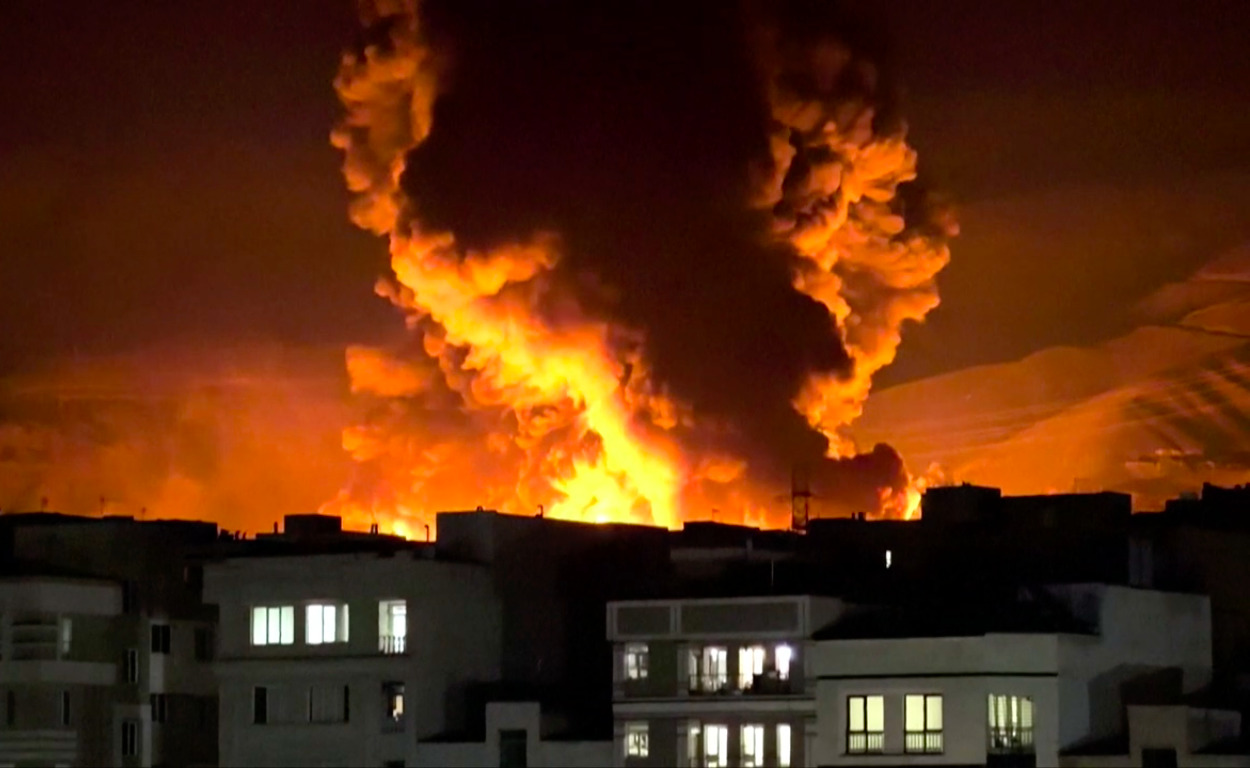
Black smoke and flames rise after the Israel Defense Forces strike several oil depots in Tehran on March 7. Photo courtesy of the British Broadcasting Corporation.
The United States and Israel launched joint attacks on Iran on Feb. 28. Iran responded with attacks on U.S. and Israeli-associated locations across the Middle East.
Dr. Kristin Zuhone, a political science professor who teaches international law at UAA, said recent U.S. interventions have made many students pessimistic about the effectiveness of international law.
“The capture of President Maduro in Venezuela, the assassination of Ayatollah Khamenei in Iran … arguably violated international law,” she said, citing the United Nations Charter’s prohibition on the use of force between states without authorization or a claim of self-defense.
Zuhone said one possible reason for optimism is that the Trump administration has felt compelled to justify its foreign policy using the language and logic of international law, suggesting its power may lie less in enforcement and more in shaping global discourse about political legitimacy.
UAA political science department chair Dr. Forrest Nabors also commented on whether the attacks on Iran complied with international law.
“Probably not in our case; probably yes in the case of Israel, although the U.N. Security Council did not authorize the attack,” he said. “It certainly is a big gamble.”
Nabors questioned the equitability of international law and added that according to the U.S. Declaration of Independence, nations that habitually violate their citizens’ natural rights forfeit their claim to sovereignty.
When asked whether that standard could apply to Israel, which human rights organizations such as Amnesty International have described as an apartheid state due to its policies toward Palestinians, he said the declaration requires “a long train of abuses,” not a few offenses.
Nabors said time will tell whether the strikes on Iran were prudent.
Assistant professor of political science Dr. Joseph Warren said, “The most important thing Americans should keep in mind is history.”
“This includes the US-backed coup of the democratically elected leader of Iran, Mohammad Mosaddegh, in 1953, the close US alliance with the authoritarian regime of Shah Mohammad Reza Pahlavi,” said Warren.
He also cited U.S. support for Iraq during the 1980s war with Iran, the U.S. unilateral withdrawal from the Iran nuclear deal while Iran was complying with the agreement, and the U.S.-Israeli bombing of Iran in June 2025 that killed more than 1,000 Iranians as historical examples.
“Americans should then ask themselves several questions: What happens next?” said Warren. “Are everyday Iranians likely to be more or less favorable toward America after US bombs inevitably kill many innocent people?”
Correction 3/22/2026 at 3pm AKST: An earlier version of this story incorrectly abbreviated an individual's name and has been altered to reflect the correct abbreviation.


.png)


.jpg)
