
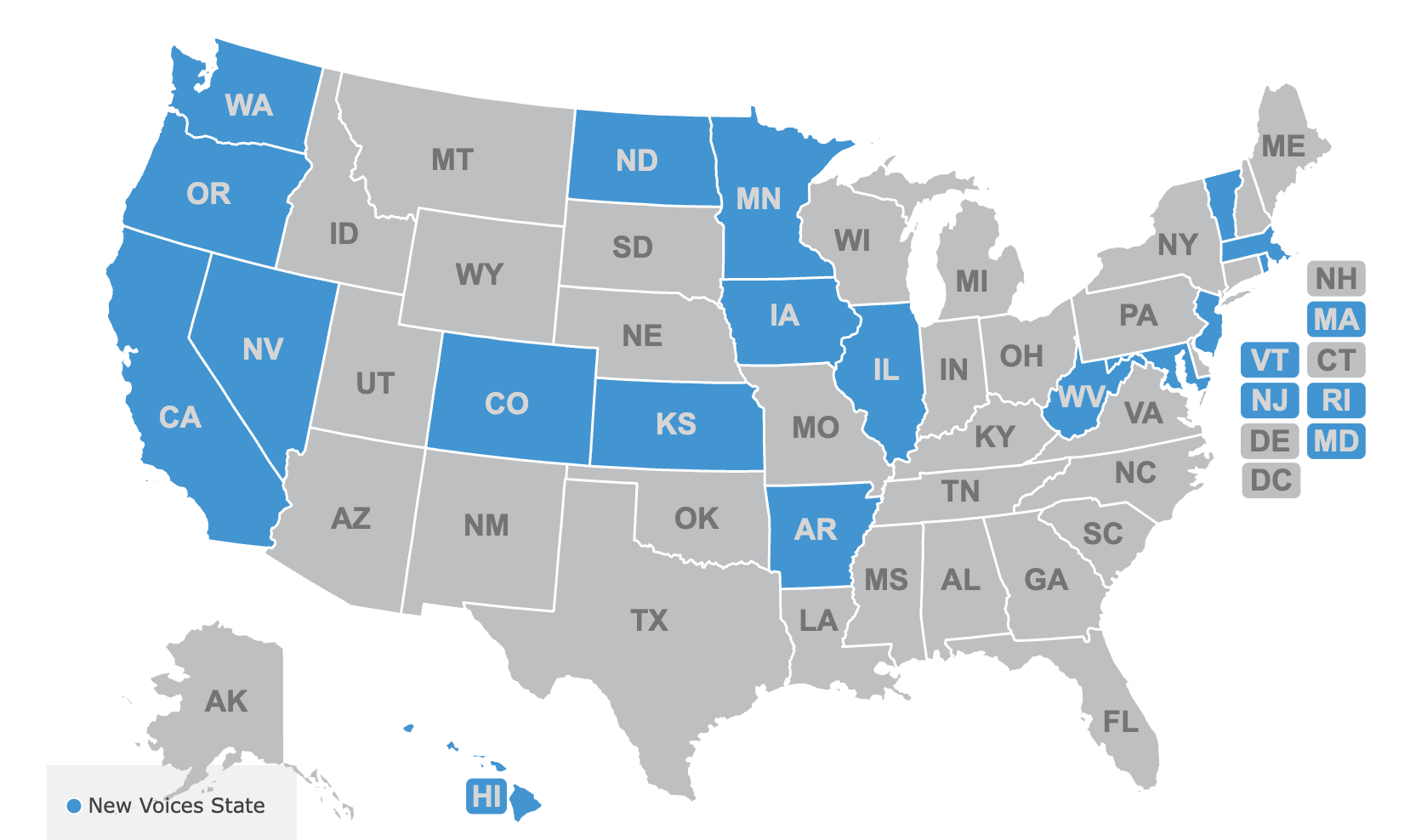
Map of states protecting student voices through legislation. Screen shot taken from Student Press Law Center website.
The State of Alaska must adopt New Voices legislation to protect student journalists and the strength of our First Amendment as a whole.
Censorship of journalism has become more prevalent in recent months — from prior review in the Pentagon to firing student media staff who refused to censor students.
New Voices legislation confronts these issues by protecting those who report, edit and advise student media from censorship and suppression of their voices. With censorship on the rise, we must pass laws that reflect the ideals we value: freedom and truth.
We cannot allow a vital pillar of our democracy to be degraded by inaction; instead, we must foster a community for future journalists and the mentors who guide them, as student journalism is an essential public service.
Student reporters are often the first to investigate issues affecting their schools, safety, administrative decisions and local communities. When their voices are restricted, we lose unique perspectives and reporting.
Student journalists are held to the same standard as professional journalists and must take accountability for mistakes, just as the Associated Press or New York Times.
Student media courses create the opportunity for prospective journalists to gain experience and prepare them for real-world situations.
It is invaluable to allow students the opportunity to develop a relationship with the community around them through student media.
The case of Hazelwood v. Kuhlmeier is evidence that the rights of student journalists have been censored or suppressed in their reporting by authority figures in academic institutions on multiple occasions.
The case establishes that censorship is under the determination of reasonability. What is “reasonable” is interpretive, and what constitutes as reasonable to one, may be immoral to the other.
By allowing students to report and write with transparency, Alaska can join a growing coalition of states in setting the example that free speech is not optional for safeguarding democracy — it’s mandatory.


.png)


.jpg)
